Salomon Unveils the Brigade Index Helmet: the First Recyclable Winter Sports Helmet
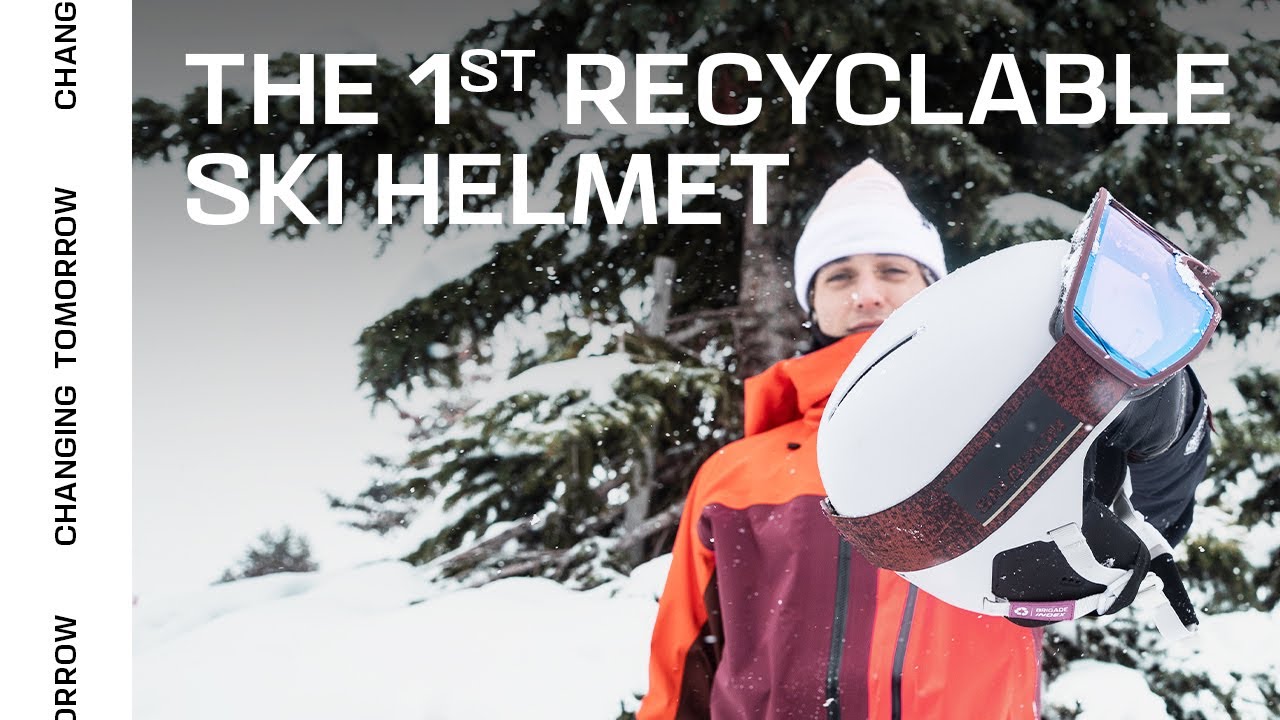
A project 4 years in the making, the Brigade INDEX ski and snowboard helmet can be fully recycled at the end of its life. Brigade INDEX represents a totally new approach to helmet construction, using 96% of materials from a single plastics family
To create the Brigade INDEX helmet, the R&D team at Salomon developed technical solutions that enabled them to make a helmet comprised of a single material family while not compromising at all on performance and safety. The use of a single material family allows the Brigade INDEX helmet to be ground down and recycled at the end of its life without any disassembly.
The overall environmental impact of the Brigade helmet is reduced by 19% compared to a “traditional” Brigade helmet. This is due to the use of polyolefins—especially polypropylene—which require less energy than other thermoplastics to produce, and due to the recycling process at the end of the helmet’s life.
“A traditional helmet is very complex to recycle because it mixes different materials and we can't separate those materials at the end of the helmet’s life, which is why helmets often end up in a landfill or burned. So we needed to find a way to use materials from the same family for all parts, to create a simple recycling process. ”
Nans Girodengo
Research & Development Specialist for Salomon’s Protective team
THE CHALLENGES OF MAKING A RECYCLABLE SKI HELMET
In 2019, Salomon’s winter sports team began researching ways to improve the environmental impact of its products. In the helmet category, it became clear that the expanded polystyrene used in the core of helmets had a significant impact on the environment, so the R&D team began looking for solutions to replace it with a less impactful material. They quickly found one, along with a supplier for the material.
Encouraged, the team upped its ambitions. Inspired by the first concept of the INDEX.01 recyclable running shoe that had just been unveiled by the Salomon Footwear team on the other side of the company’s Annecy Design Center (ADC) headquarters, the winter sports team began exploring end-of-life improvements and recyclability for helmets. This proved to be a significant, but not impossible, challenge.
“A traditional ski and snowboard helmet is a very complex product to recycle because it generally mixes a number of materials to create the shell, core, buckles, straps and the comfortable interior,” says Nans Girodengo, Research & Development Specialist for Salomon’s Protective team. “There isn’t a way to separate all those materials at the end of the helmet’s life, which is why helmets often end up in a landfill or burned. So we needed to find a way to use the same material, or materials from the same family, for all these parts to create a simple recycling process. At the same time, we of course needed to meet all the same strict safety standards of every other helmet in our range.”
“The outer shell is the most subject to scratching and damaging, but internal testing found that polypropylene didn’t create any issue regarding durability. We even sent some Brigade INDEX helmets to ski schools, who are known for having a quite intense use of their gear. No issue was raised following these tests either!”
Nans Girodengo
Research & Development Specialist for Salomon’s Protective team
STARTING FROM SCRATCH WITH ONE FAMILY OF MATERIAL
The Brigade INDEX project started with a scary notion: discarding all the existing materials, pieces and processes that Salomon had relied on and fine-tuned over 22 years of making helmets. Working with Paprec—a French specialist in waste management, recycling and revalorization of materials—the Salomon team searched for one material family that could be used for the entire helmet.
They settled on polypropylene (PP), a thermoplastic that can be heated and shaped in various forms, and also requires less energy than other thermoplastics to be produced, which would further reduce the overall environmental impact of the helmet. From there, they began redesigning every helmet component using material from the polypropylene family to reach the same level of comfort and protective performance.
“The stars really aligned during the development of this project because the demand for recycled materials had been strongly increasing and Paprec mentioned that there was a heavy need for recycled PP, especially in the automobile industry,” says Thibaut Montagnoni, Research & Development Project Manager for the Salomon’s Protective team. “They had already constructed a circuit for PP to be recycled, which led us to explore the feasibility of using it for this helmet project.”
During the development process, the R&D team tested 10 different constructions for the helmet, including various types and shapes of polypropylene and different injection techniques. They expected the outer shell and inner core, which are the most important pieces in terms of protection and shock absorption, to be the most difficult to create. Through extensive testing, however, they learned that polypropylene has great durability and resistance to scratches, in addition to great shock absorption when expanded.
“The outer shell is the most subject to scratching and damaging, but internal abrasion testing found that polypropylene offered great resistance to damage and didn’t create any issue regarding durability once the finish coating was applied,” describes Nans Girodengo. “We sent some Brigade INDEX helmets to ski schools, who are known for having a quite intense use of their gear. No issue on quality or durability was raised following these tests either. For the inner core, we also discovered that EPP4D, the expanded version of polypropylene, did a better job at absorbing micro-impact and reforming back to its original shape after an impact than expanded polystyrene (EPS4D).”
The helmet was constructed with a sustainable approach, removing any superfluous parts. The rivets used to connect the neck strap to the helmet were replaced with a slot in the outer shell where the strap is sewed onto itself. The goggle retainer was changed from a combination of a riveted strap attached to an elastic to a simple plastic piece.
In the end, the helmet uses 96% polypropylene. It’s used in the form of pellets injected into molds for the outer shell, expanded polypropylene in the core, and weaved strings of polypropylene in the textile components. Paprec has certified that the helmet is “fully recyclable,” because it reaches the threshold of using 95 percent of its material from the same family. Some exceptions had to be made to keep specific properties of rigidity and comfort:
- The male part of the buckle and the adjustment wheel in the back of the helmet use polyoxymethylene (POM) to ensure the same level of rigidity over time and avoid distortion.
- The padding around the ears as well as parts of the helmet’s core uses EVA for comfort reasons.
“We estimate that a helmet can last for 5 years, so we know we won’t receive many helmets during the first years. But we need to educate our consumers on the process of sending the product back instead of just disposing of it. ”

Benjamin Raffort
Responsable produit de l’équipe protection
HOW TO RECYCLE A BRIGADE INDEX HELMET
To recycle the Brigade INDEX helmet, consumers need to ship it to a collection center at the end of its life by scanning the QR code on the tag, printing the shipping label, and dropping it off at their nearest post office, all free of charge. The helmets will then be sent to the PAPREC facility in Verdun, FRANCE, to be ground down and recycled into flowerpots, car bumpers, or terrace studs. No need for any disassembly, even if the helmet has components that aren’t made with polypropylene: PAPREC will filter out any other material to make sure that the recycled material is pure polypropylene.
Each helmet that is sent back will be sent to Paprec to be recycled. Because Paprec is able to mix the ground down helmets with other recycled polypropylene, there is also no need to wait for a large number of helmets to be recycled in bulk.
“We estimate that a helmet can last for 5 years, considering it is used 10 days per year and we know we won’t receive many helmets during the first years, but this is a long-term project,” explains Benjamin Raffort, Product Line Manager for the Protective team. “We know that we need to educate our consumers on the process of sending the product back instead of just disposing of it,” says Raffort. “This has already been started thanks to the Salomon INDEX Road running shoe, which can also be sent back for recycling at the end of its life. We know that exploring these topics will create a virtuous circle, with more people being eager to take the extra steps that will allow more products to be recycled.”
“The Salomon Winter Sports department has been working extensively for years on reducing the environmental impact of its products,” explains Xavier Le Guen, Vice-President for Salomon Winter Sports. “The Trash is Gold project is a great example of how to use discarded plastic from ski production in ski edges, snowboard bindings and ski and snowboard bases. Earlier this year, Salomon published the life-cycle analysis of key products, including Nordic and alpine skis, snowboards, bindings, helmets, and goggles, in order to know the environmental impact of each step in the product creation process, from the sourcing of materials all the way to the product end of life management. In this way, the LCA work is directly informing the global climate strategy of Salomon with science-based data. The fact that we have openly shared the results of all our LCA is also a way to contribute to the broader transformation of the industry.”
In 2025, the whole Brigade range will be replaced with Brigade INDEX helmets, including the MIPS version.
Původně zveřejněno 4 led. 2024
Související články
Zobrazit všechny příběhy


